Walk into any lighting shop today and almost everything on the shelf runs on LEDs — bulbs, battens, panel lights, street lights, decorative strips. But here’s something most buyers only learn after a product fails: the LED itself rarely dies first. What usually gives up is the board underneath it. If an LED product dims noticeably within a year or starts flickering in summer, nine times out of ten the culprit is heat that the PCB couldn’t pull away from the chip.
We manufacture LED PCBs every week at our unit in Derabassi, and this question comes up in almost every enquiry call: “FR4 chalega ya aluminum lena padega?” So in this guide we’ll explain, in plain language, how LED PCBs are different, when a normal board is fine, when you genuinely need a metal core PCB (MCPCB), and what to check before you place a bulk order.
Why LED PCBs Are Not Just Regular Circuit Boards
A power LED converts only a part of its energy into light. The rest becomes heat, and that heat has nowhere to go except down — through the solder pad, into the board. An LED junction that runs hot loses brightness month by month (the industry calls it lumen depreciation) and its life drops sharply. A chip rated for 50,000 hours at 85°C might not cross 20,000 hours if it keeps running at 105°C.
Standard FR4 — the green fibreglass material used in most electronics — is actually a poor conductor of heat. That’s fine for a TV remote or a Wi-Fi router. It’s a problem when you mount thirty 0.5W LEDs on a small round board inside a closed bulb housing. This is exactly why the LED industry moved to aluminum-based boards.
What Is an Aluminum PCB (MCPCB) and How Does It Work?
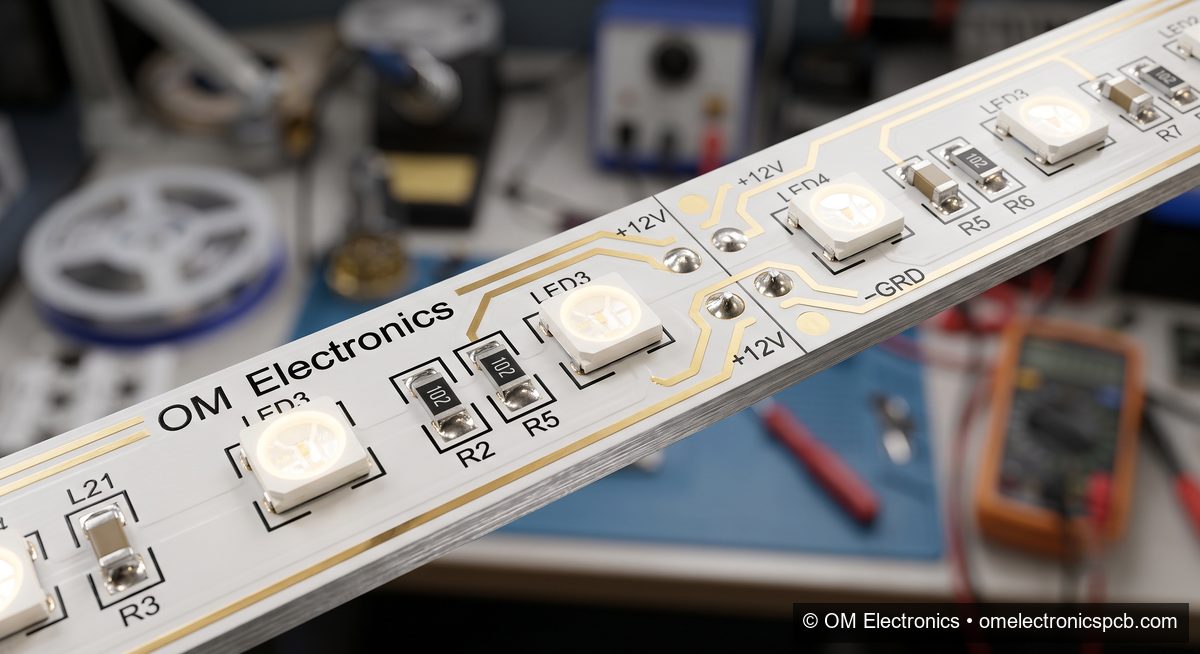
A metal core PCB looks like a normal single-sided board from the top, but its base is an aluminum sheet instead of fibreglass. The construction is a simple three-layer sandwich:
- Copper circuit layer on top — your tracks and LED pads, same as any PCB.
- Thermally conductive dielectric in the middle — a thin insulating layer that blocks electricity but lets heat pass through.
- Aluminum base at the bottom — typically 1.0mm to 1.6mm, which spreads the heat and hands it over to the housing or heatsink.
The result: heat travels away from the LED junction several times faster than it would on FR4. In our own testing on 9W bulb boards, the same LEDs run visibly cooler on aluminum — you can feel the difference on the housing within ten minutes of switching on.
FR4 or Aluminum — Which One Does Your Product Need?
Honest answer: not every LED product needs a metal core board, and a good PCB fabrication partner should tell you when the cheaper option is enough.
- Indicator LEDs, low-power strips, decorative items — FR4 is perfectly fine. The heat is negligible.
- Bulbs, downlighters, tube lights, panel lights (0.5W–1W LEDs in numbers) — single-sided aluminum PCB is the industry standard. This covers most of the LED lighting made in India.
- Street lights, flood lights, high-bay fixtures (1W–3W+ power LEDs) — aluminum is non-negotiable, and dielectric quality plus copper weight (1oz vs 2oz) start to matter.
One more thing buyers often miss: shape. LED boards are rarely rectangular. Round boards for bulbs, long narrow strips for battens, custom cutouts for fittings — the board outline has to match your housing exactly, so accurate CNC routing/punching matters as much as the material.
How We Make LED PCBs at OM Electronics
We’ve been manufacturing PCBs for over 25 years, and LED lighting boards — round MCPCBs for bulbs, strips for tubes and battens, driver boards on FR4 — are one of the largest parts of our production. Manufacturers from Mohali, Zirakpur, Chandigarh and across North India send us their samples or drawings, and our process is straightforward:
- You share a sample, a drawing, or Gerber files — any of the three works.
- We suggest the right material stack (FR4 or aluminum, dielectric grade, copper weight) for your wattage and housing.
- You get prototype pieces first, test them in your actual fitting, and only then commit to bulk.
- Bulk production runs with 100% electrical testing before dispatch.
Because fabrication happens at our own unit, turnaround for repeat LED jobs is fast and pricing stays direct — no trader margin in between.
Frequently Asked Questions
What is the difference between MCPCB and aluminum PCB?
Practically none — people use the terms interchangeably. MCPCB (metal core PCB) is the family name; aluminum is simply the metal used in almost all LED lighting boards because it’s light, cheap and conducts heat well. Copper-core boards exist but are reserved for special high-power applications.
Is an aluminum PCB much costlier than FR4?
Per piece, yes — the raw material costs more. But for lighting products the comparison is misleading: an FR4 board in a hot fixture leads to dimming LEDs, warranty returns and brand damage that cost far more than the few extra rupees per board.
Can you manufacture custom shapes like round bulb boards or long batten strips?
Yes. Round MCPCBs from small diameters for bulbs up to long strips for tube lights and battens, with custom outlines matching your housing drawing. Send us the sample or DXF and we’ll take it from there.
Key Takeaways
- Heat, not the LED chip, is what kills most LED products early — the PCB is your first line of defence.
- FR4 is fine for low-power LEDs; anything from bulbs upward should be on a single-sided aluminum PCB.
- For street and flood lights, dielectric grade and copper weight matter — discuss them before ordering.
- Always test prototypes inside your actual housing before bulk production.
Get Your LED Boards Made Right
If you’re building or sourcing LED lighting products and want boards that keep their brightness year after year, we’re happy to help — whether it’s a 50-piece trial or regular monthly production. Get in touch with our team with your sample or Gerber files, or read more about OM Electronics and our 25+ years in PCB manufacturing.