If you’ve spent any time sourcing PCBs, you’ve probably come across the same handful of giant names over and over — companies with dozens of factories, thousands of employees, and revenues that make most of us look like a hobby shop. I wanted to put together an honest rundown of who actually leads the global PCB industry today, based on scale and reputation, and then talk a bit about where a company like ours fits into that picture — because we’re not pretending to compete with a $2 billion Taiwanese conglomerate, but we do think there’s a real story in how Indian PCB manufacturing is catching up.
1. Zhen Ding Technology (Taiwan)
Zhen Ding is usually the name at the very top of any PCB revenue list. They’re a core supplier for the smartphone and consumer electronics supply chain, with a huge footprint in mainland China. If you own a phone from a major brand, there’s a decent chance a Zhen Ding board is inside it somewhere.
2. TTM Technologies (USA)
TTM is one of the few US-headquartered PCB majors, and they’re heavily involved in aerospace, defense, and networking hardware — sectors where certification and traceability matter as much as the board itself. They’ve grown a lot through acquisitions over the years.
3. Unimicron Technology (Taiwan)
Unimicron is a big player in IC substrates and high-density interconnect (HDI) boards — the tech that goes into everything from laptops to advanced packaging for chips. Their scale in Taiwan and China is enormous.
4. Compeq Manufacturing (Taiwan)
Compeq focuses a lot on flexible and rigid-flex PCBs, which is a specialty a lot of manufacturers avoid because it’s genuinely hard to get right. They supply into wearables and compact consumer devices where space is at a premium.
5. Tripod Technology (Taiwan)
Tripod’s strength is in multilayer boards for industrial and communications equipment. They’ve built a name for consistency at high volume, which is exactly what a lot of OEMs need when they’re ordering hundreds of thousands of units.
6. Kinwong Electronic (China)
Kinwong is one of the fastest-growing names on this list, serving automotive electronics, telecom, and industrial control boards. China’s domestic EV boom has been a big tailwind for them.
7. AT&S (Austria)
AT&S is one of the only major European names in this space, and they’ve carved out a strong position in automotive and medical-grade PCBs — industries where a single failed board can mean a recall or worse, so their quality systems are taken very seriously.
8. WUS Printed Circuit (China)
WUS has been around for decades and covers a huge range of board types, from simple single-layer to complex multilayer designs, serving everything from home appliances to telecom infrastructure.
9. Shennan Circuits (China)
Shennan is a major supplier into networking and data center hardware — the unglamorous but critical boards that keep servers and switches running. Their growth has tracked closely with the global data center buildout.
10. Ibiden (Japan)
Ibiden rounds out the list with a strong reputation in package substrates for semiconductors, alongside more traditional PCB lines. Japanese manufacturing standards are baked into everything they do, which shows in their defect rates.
So Where Does India — and OM Electronics PCB— Fit In?
None of the above are Indian companies, and it would be dishonest to pretend otherwise. What’s changed in the last few years is that India has stopped being just a design and assembly destination and started building real PCB fabrication capability of its own, especially for prototyping, quick-turn runs, and small-to-mid volume production — the segment large offshore manufacturers often aren’t set up to serve well because their minimum order quantities and lead times don’t work for an Indian startup or a mid-size electronics company that needs 50 boards next week, not 50,000 boards next quarter.
That’s the space we work in at OM Electronics PCB, based out of Derabassi, Punjab, near Chandigarh and Mohali. We’re not going to claim we’re competing with Zhen Ding’s factory floor — nobody serious would say that. What we can say is that for a lot of Indian engineers and companies, ordering from a manufacturer that’s a phone call away, understands local compliance, and can turn around a Gerber file into a working prototype in days rather than weeks, ends up mattering more than raw scale. We do single-side through 8-layer multilayer PCBs, and quick-turn prototyping with no minimum order quantity, backed by 100% electrical and visual QC before dispatch — and we’re currently completing our ISO 9001:2015 certification process.
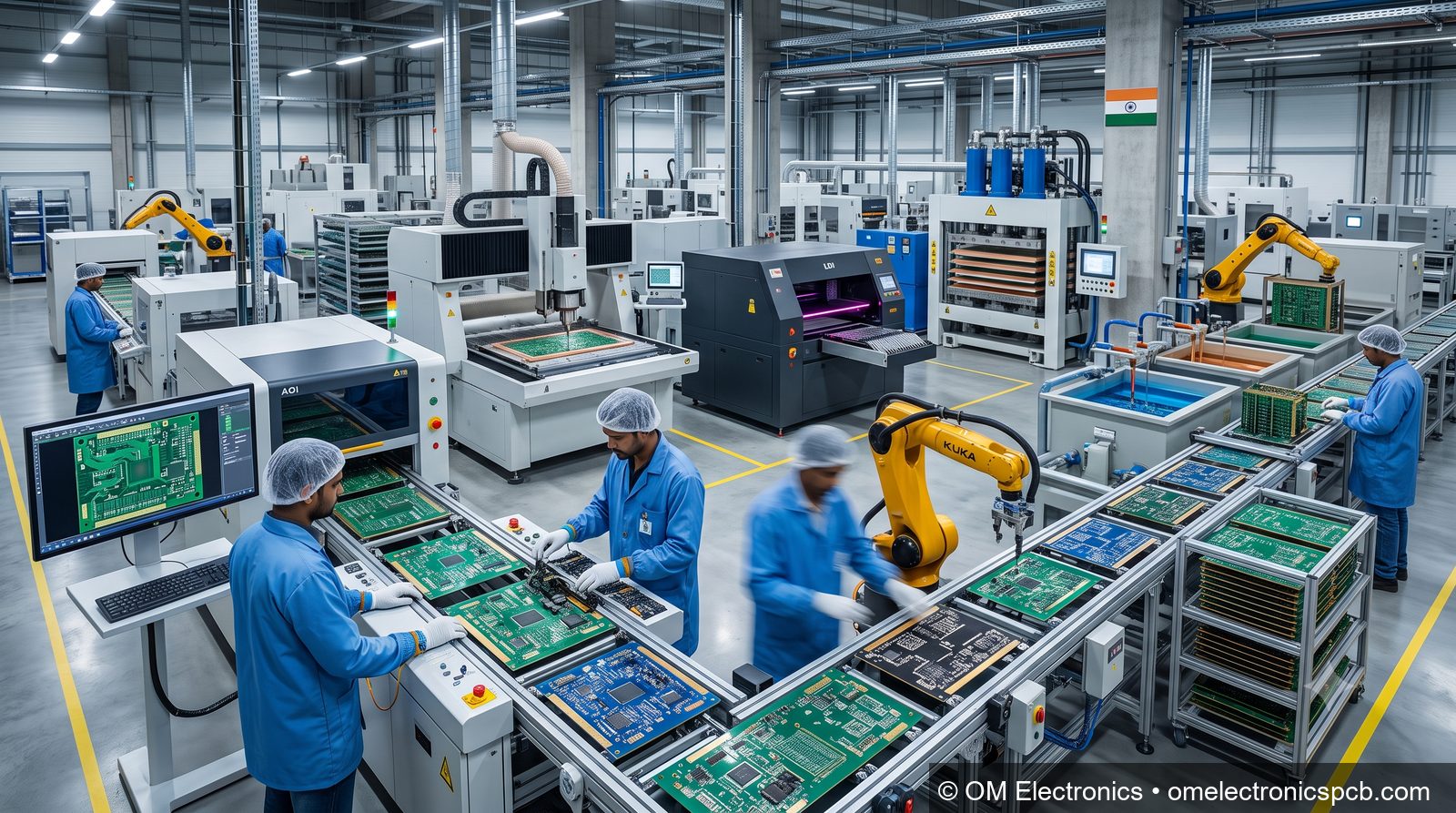
If you’re evaluating PCB manufacturers in India and want to see how a growing manufacturer handles prototyping through to production, our PCB fabrication and PCB prototyping pages walk through our process, or you can get in touch directly for a quote.